The original equipment manufacturer’s refresh cycle is often designed to serve their sales targets rather than your operational requirements. You’ve likely felt the pressure of exorbitant support costs as your hardware ages, or struggled to find consistent technical talent for your remote facilities across Canada. It’s a common frustration for enterprise IT leaders who want to maintain stability without overspending on End of Service Life transitions. Relying on professional onsite server maintenance services provides a more logical path forward. This approach allows you to shift from reactive troubleshooting to a standardized, methodical strategy that prioritizes the health of your physical infrastructure.
This guide demonstrates how shifting to third-party maintenance can reduce your annual spend by 30% to 40% while extending the functional lifespan of your existing assets. You’ll learn how to implement a unified support model that ensures reliability across every national site, regardless of its distance from your primary data centre. We’ll also examine the logistical steps required to optimize uptime and manage your hardware lifecycle with confidence. By the end of this article, you’ll have a clear framework for balancing fiscal responsibility with high-performance infrastructure management.
Key Takeaways
- Transition from reactive break-fix models to proactive onsite management to ensure consistent server uptime across all national facilities.
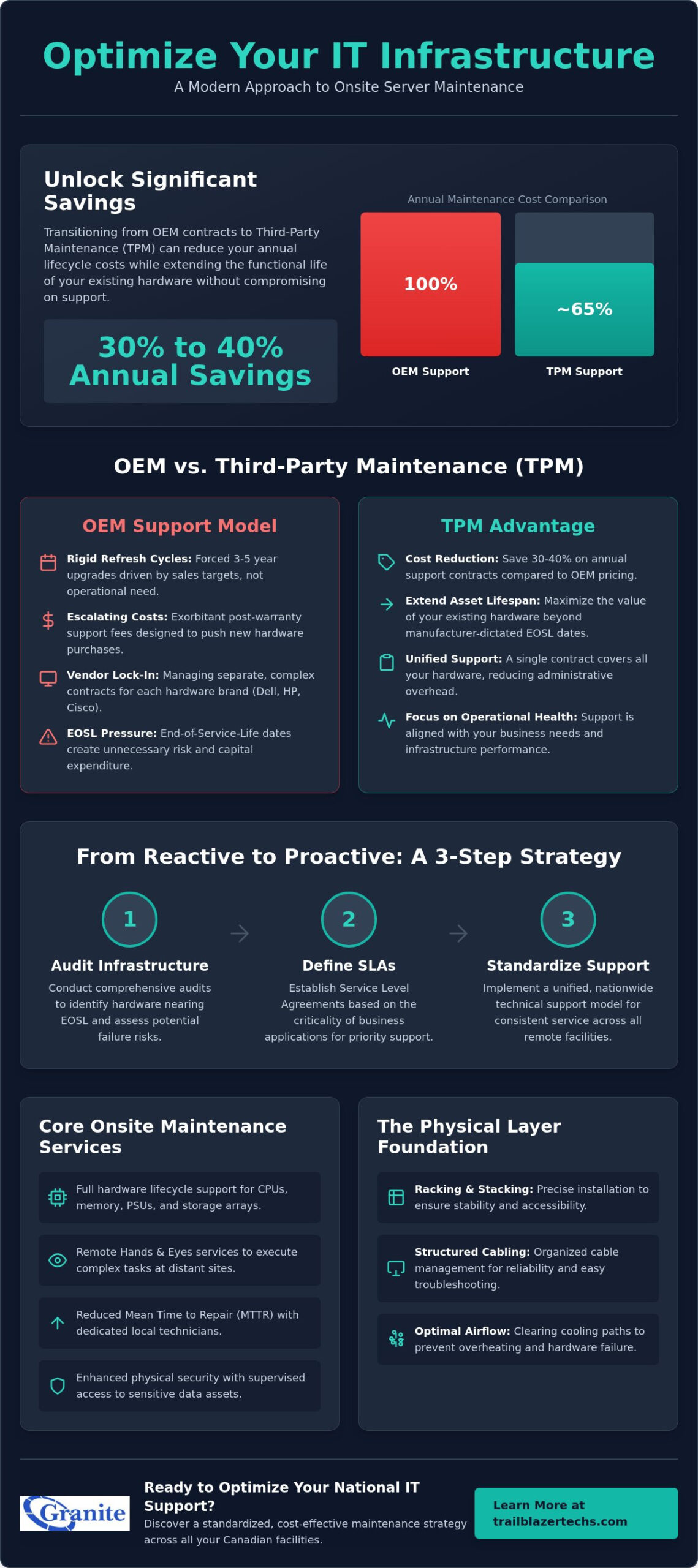
- Discover how professional onsite server maintenance services and third-party maintenance (TPM) can reduce lifecycle costs by 30% to 40% compared to OEM contracts.
- Identify the critical role that precise racking, stacking, and structured cabling play in maintaining optimal airflow and hardware reliability.
- Learn to mitigate End of Service Life (EOSL) risks by conducting infrastructure audits and defining SLAs based on the criticality of your business applications.
- Streamline complex nationwide hardware rollouts by leveraging a standardized technical support model across all Canadian locations.
What are Onsite Server Maintenance Services?
Onsite server maintenance services represent the physical foundation of a resilient enterprise IT strategy. This service model provides professional technical labor and hardware support delivered directly at the equipment’s physical location. While remote monitoring handles software and logical layers, onsite support addresses the tangible components that keep a business operational. In a Canadian market where facilities are often spread across vast distances, having a standardized approach to physical hardware care is a logistical necessity. The focus has shifted away from the traditional, reactive break-fix model. Instead, modern enterprises utilize a proactive management style that identifies potential hardware failures before they result in costly downtime.
By 2026, the demands on physical infrastructure have intensified. The global data center maintenance and support services market is projected to reach $8.1 billion this year, driven largely by the specialized requirements of AI workloads and high-density computing. Organizations are prioritizing onsite support to manage the complexities of hybrid cloud environments. Maintaining the physical layer requires a methodical approach to hardware troubleshooting, component replacement, and regular audits of the environment’s health. This ensures that the underlying data center infrastructure, including power and cooling systems, remains capable of supporting mission-critical applications.
The Scope of Modern Onsite Support
Modern onsite support covers the entire lifecycle of server hardware. This includes the technical management of CPUs, memory modules, power supplies, and storage arrays. Technicians don’t just replace parts; they ensure that the physical layer integrity is maintained through precise cable management and the clearing of cooling paths. Services such as Remote Hands & Eyes allow centralized IT teams to execute complex tasks at distant Canadian sites without the need for travel. This local presence is essential for maintaining storage systems support and ensuring that every piece of hardware is correctly integrated into the broader network.
Benefits of a Dedicated Onsite Strategy
Implementing a dedicated onsite strategy results in a significant reduction in Mean Time to Repair (MTTR). When a local technician is already familiar with the site’s layout and protocols, hardware issues are resolved with much greater speed. This approach eliminates the high travel costs and lost productivity associated with sending internal senior engineering staff to remote locations. Furthermore, it enhances physical security. Professional onsite server maintenance services provide supervised access to sensitive hardware, ensuring that only qualified personnel interact with your data assets. This organized methodology creates a stable environment that extends the functional lifespan of your hardware beyond the standard refresh cycles dictated by manufacturers.
OEM vs. Third-Party Maintenance (TPM): Evaluating the ROI
Original Equipment Manufacturers (OEMs) typically operate on a rigid three-to-five-year refresh cycle. This schedule is often driven by their internal sales targets rather than the actual performance or health of your hardware. For many Canadian enterprises, these forced upgrades lead to unnecessary capital expenditure and the disposal of assets that still possess significant utility. Evaluating the return on investment (ROI) between OEM support and third-party maintenance (TPM) requires a clear understanding of your infrastructure’s lifecycle. While OEMs provide essential updates for new technology, TPM providers offer a more flexible approach to onsite server maintenance services that aligns with the actual operational needs of your equipment.
The financial advantage of TPM is rooted in its operational efficiency. By decoupling hardware support from the manufacturer, enterprises can avoid the escalating costs of post-warranty OEM contracts. This model typically offers 30% to 40% savings, which is particularly impactful for organizations with a diverse mix of hardware vendors. Instead of managing separate, expensive contracts with Dell, HP, or Cisco, a single TPM agreement provides a unified support structure. This consolidation reduces administrative overhead and simplifies the management of onsite server maintenance services across your entire Canadian footprint. If you’re looking to optimize your infrastructure budget, exploring third party hardware maintenance services options can provide the necessary fiscal relief without compromising stability.
The transition to End of Service Life (EOSL) status is a critical moment for any data center. OEMs use this designation to signal the end of their support, but it doesn’t mean the hardware is obsolete. TPM providers specialize in supporting these legacy systems, providing the parts and labor required to keep them running reliably. This capability extends the lifespan of your hardware and allows for a more controlled, logical transition to newer generations of technology. It shifts the power back to the IT leader, allowing you to decide when a refresh is truly necessary based on performance metrics rather than manufacturer mandates.
When to Stick with OEM Support
There are specific scenarios where maintaining an OEM contract is the correct technical decision. High-frequency proprietary firmware updates are often required during Day-1 deployments or for highly specialized hardware that lacks third-party parts availability. Additionally, certain compliance mandates may require manufacturer-direct certification for specific workloads. Most organizations choose to stay with the OEM during the initial three-year warranty period, as the support costs are typically bundled into the purchase price of the hardware.
The Advantages of Third-Party Maintenance
TPM offers flexible SLAs that can be tailored to the criticality of a specific site rather than following generic manufacturer tiers. This is especially useful for remote Canadian locations that may not require a four-hour response time but still need reliable, professional support. A TPM provider acts as a single point of contact for multi-vendor environments, streamlining the troubleshooting process. This approach delays capital-intensive hardware refreshes, allowing you to extract maximum value from every asset in your rack.
The Physical Layer: Racking, Stacking, and Cabling Logistics
Physical infrastructure management is the bedrock of server stability. While many providers focus on software patches or contract renewals, the most frequent causes of hardware failure often stem from the physical environment. Precision in the physical layer ensures that your hardware operates within its designed parameters. Professional onsite server maintenance services must account for the logistical realities of the server room, starting with the physical placement of the equipment itself. If the physical foundation is neglected, even the most expensive software monitoring tools can’t prevent a failure caused by overheating or a loose connection.
Proper airflow and thermoregulation are directly influenced by how hardware is installed. In high-density 2026 data centers, where AI-driven workloads generate significant heat, even a minor misalignment can disrupt cooling paths. This leads to thermal throttling or premature component failure. Methodical racking and stacking ensure that cold aisles and hot aisles function as intended, protecting your investment from avoidable environmental stress. By maintaining these standards, you reduce the mechanical strain on internal fans and power components, which directly extends the equipment’s lifecycle.
Best Practices for Rack and Stack
Rack and Stack is the professional installation of hardware into standardized frames. This process requires careful attention to weight distribution; heavier storage arrays and power supplies are placed at the bottom of the rack to maintain a low center of gravity and prevent tipping. Rail alignment is equally critical to ensure hardware is secure and accessible for future servicing. Standardized labeling and documentation are implemented at this stage, creating a roadmap that allows technicians to identify and troubleshoot specific units without delay. This level of organization is what separates a professional installation from a temporary fix.
The Criticality of Structured Cabling
Structured cabling acts as a preventative maintenance measure by significantly reducing the risk of port errors and accidental disconnects. When cables are managed in an organized fashion, the “cable spaghetti” that plagues many server rooms is eliminated. This clarity is vital during onsite server maintenance services, as it allows technicians to work on specific components without disturbing adjacent connections. Utilizing high-quality fiber or copper with clear color-coding supports high-bandwidth requirements and makes future hardware migrations much simpler. An organized cabling system ensures that your infrastructure can scale without the logistical friction of a tangled physical layer. It provides the clean, reliable connectivity required for 2026’s high-speed data demands.
Developing a Proactive Server Maintenance Strategy
A proactive maintenance strategy transforms IT from a cost center into a stable foundation for growth. Effective onsite server maintenance services require more than just reacting to hardware alarms; they involve a systematic review of every physical asset across your Canadian facilities. By shifting the focus from hardware age to application criticality, you ensure that resources are allocated where they impact the business most. A server running a primary database in a critical facility requires a different response protocol than a secondary backup unit in a remote branch. This methodical approach reduces the risk of unexpected downtime and ensures that your infrastructure remains resilient against the demands of modern workloads.
Consistency is the primary challenge for organizations with a national footprint. Without a standardized protocol, the quality of onsite interventions can vary significantly between regions. Implementing a rigorous framework for technical labor ensures that every technician follows the same diagnostic and reporting procedures. This methodology provides your centralized IT team with clear, “eyes-on” verification of the physical state of your equipment. For organizations managing complex deployments, utilizing Remote Hands & Eyes services provides the reliable local presence needed to maintain high availability without the logistical burden of internal travel.
The Infrastructure Audit: Your Starting Point
A comprehensive audit is the first step in mitigating End of Service Life (EOSL) risks. You must inventory all assets across every national location to identify hardware that is approaching manufacturer support boundaries. This process often reveals hidden risks, such as outdated storage systems or degraded cabling, that might have been overlooked during remote monitoring. Creating a lifecycle roadmap for 2026 and beyond allows you to plan for upgrades and maintenance spend with precision. It prevents the stress of emergency replacements and allows for a more controlled budgetary cycle.
Standardizing Onsite Technical Labor
Standardizing technical labor ensures that your infrastructure receives the same level of care in rural sites as it does in major urban centres. Field technicians should be leveraged for more than just repairs; they’re valuable resources for conducting site surveys and physical health checks. Detailed onsite reporting provides a documented history of your hardware, which is essential for audit compliance and long-term planning. This disciplined approach to technical labor ensures that every intervention adds value to your overall infrastructure health.
To implement this strategy effectively, follow this practical checklist for every onsite intervention:
- Verify power redundancy and PDU health to ensure continuous operation.
- Inspect cooling paths for obstructions or fan failures that could lead to thermal stress.
- Audit physical cable security and labeling accuracy to prevent accidental disconnects.
- Update the centralized asset registry with current EOSL status for accurate lifecycle planning.
- Confirm that local environmental sensors and monitoring hardware are fully operational.
National Scope Support: The TrailBlazer Techs Advantage
Managing enterprise infrastructure across Canada presents unique logistical hurdles that localized providers often struggle to overcome. Fragmented support models typically result in inconsistent service levels and varying response times between urban hubs like Toronto and remote satellite offices. TrailBlazer Techs addresses these challenges by providing a unified framework for onsite server maintenance services. Our approach ensures that every facility receives the same rigorous attention to detail, regardless of its geographic coordinates. By acting as a single point of accountability, we eliminate the administrative burden of managing multiple local vendors. This consistency is vital for maintaining the high availability standards required by modern commercial IT operations.
Why National Reach Matters for Maintenance
A national reach provides more than just geographic coverage; it offers standardized project management for multi-site deployments. When your organization initiates a hardware refresh or a complex upgrade, having a partner who understands your entire footprint is essential. TrailBlazer Techs provides unified coordination for Nationwide Rollouts, ensuring that technical standards are applied uniformly across the country. This model allows you to scale support up or down based on the specific requirements of your project. It removes the uncertainty of working with unknown local contractors and replaces it with a proven, methodical service delivery engine.
Comprehensive Infrastructure Services
Our expertise extends beyond basic maintenance to cover the entire physical lifecycle of your technology. We provide integrated solutions that include Structured Cabling, Racking & Stacking, and specialized Storage Systems Support. This comprehensive service suite ensures that every layer of your infrastructure is optimized for performance and reliability. Whether you’re integrating new AV Technology or requiring Point of Sale Support for retail locations, our technicians act as the “Safe Hands” for your critical assets. We invite you to contact TrailBlazer Techs for a national infrastructure assessment to determine how we can better support your Canadian operations.
Choosing a partner for your infrastructure is a decision based on trust and proven competence. By combining specialized technical labor with a deep understanding of logistical management, TrailBlazer Techs provides the stability your enterprise needs to thrive. We handle the complexities of the physical layer so your internal team can focus on higher-level strategic initiatives. It’s about more than just fixing hardware; it’s about building a foundational environment that supports your business objectives for 2026 and the years to follow. Our commitment to unwavering reliability ensures that your technical challenges are handled with methodical precision.
Strengthening Your Infrastructure for Future Growth
Managing a national IT footprint requires a shift from reactive repairs to a disciplined, proactive methodology. By decoupling your hardware support from rigid manufacturer refresh cycles, you can achieve significant cost efficiencies while extending the functional lifespan of your assets. Precision in the physical layer, specifically regarding racking, stacking, and structured cabling, remains the most effective way to prevent avoidable hardware failures. Standardizing these onsite server maintenance services across every Canadian facility ensures that your infrastructure remains a stable, high-performance environment regardless of geographic location.
TrailBlazer Techs provides the specialized technical labor needed to execute these strategies with methodical precision. Our team is deeply experienced in managing complex nationwide IT rollouts and multi-site deployments, ensuring consistent quality from coast to coast. We offer proven expertise in critical physical infrastructure tasks and provide reliable support for storage systems and deskside technology. Our goal is to lower your operational stress by handling technical complexity with unwavering reliability. Optimize Your Infrastructure with TrailBlazer Techs Onsite Services today. Your infrastructure is the foundation of your success, and it’s in safe hands with our seasoned professionals.
Frequently Asked Questions
What is the difference between onsite server maintenance and remote support?
Onsite support involves physical intervention at the hardware’s location, while remote support handles logical tasks from a distance. Onsite technicians perform tangible work like swapping power supplies, re-seating memory, or verifying physical connections. While remote teams can monitor performance, they can’t address mechanical failures. Professional onsite server maintenance services bridge this gap by providing the physical labor required to resolve hardware-level issues that software cannot fix.
How much can a business save by switching to third-party maintenance (TPM)?
Enterprises typically realize savings of 30% to 40% on their annual maintenance spend by transitioning from OEM contracts to third-party maintenance. These savings occur because TPM providers aren’t incentivized to force hardware refreshes or charge the premium associated with manufacturer branding. By focusing on the actual utility of the equipment rather than sales cycles, businesses can reallocate these funds toward strategic IT initiatives or modernizing their Canadian infrastructure.
What does “Remote Hands and Eyes” mean in a data center context?
Remote Hands and Eyes refers to a service where an onsite technician acts as the physical extension of a centralized IT team. The technician performs manual tasks such as toggling switches, labeling cables, or describing the status lights on a server chassis. This allows senior engineers to manage infrastructure at distant Canadian sites without the logistical delay or expense of travel. It’s a methodical way to maintain control over remote hardware.
Is third-party maintenance as reliable as OEM support for high-availability servers?
Third-party maintenance is often more reliable because it offers flexible SLAs tailored to your specific operational needs. Unlike the rigid tiers provided by manufacturers, TPM providers focus on maintaining multi-vendor environments with a single point of contact. This reduces administrative friction and ensures that technicians are focused on the stability of the entire rack rather than just a single brand’s equipment. It’s a specialized approach to high-performance infrastructure management.
What happens when my server reaches its End of Service Life (EOSL)?
When hardware reaches EOSL, the manufacturer ceases to provide parts or technical support, but the equipment remains functional. Third party hardware maintenance services step in to supply the necessary components and technical labor to keep these assets operational. This prevents forced capital expenditures and allows you to extend the hardware’s lifespan until a refresh is strategically necessary. It provides a logical, cost-effective path for managing aging Canadian data center assets.
Can onsite maintenance services help with nationwide hardware rollouts?
Professional onsite server maintenance services are essential for coordinating complex nationwide rollouts across multiple Canadian provinces. Technicians handle the physical installation, racking, and stacking of new units to ensure every site meets a standardized technical requirement. This unified approach eliminates the variability associated with using different local contractors. It ensures that your new infrastructure is correctly integrated into your network from the first day of deployment.
What are the risks of ignoring structured cabling during server maintenance?
Neglecting structured cabling leads to cable spaghetti, which increases the risk of accidental disconnects and port errors. Poorly managed cables obstruct airflow, causing thermal stress that shortens the lifespan of CPUs and storage arrays. During a maintenance intervention, disorganized wiring makes it difficult for technicians to identify and isolate specific components quickly. This lack of physical organization directly impacts your Mean Time to Repair (MTTR) and overall system reliability.
How do I choose the right onsite technical support partner for my business?
Look for a partner with a proven national footprint and expertise in multi-vendor hardware environments. The right provider should offer a comprehensive range of services, including racking, stacking, and structured cabling, rather than just basic parts replacement. Verify their ability to provide consistent reporting and standardized protocols across all your Canadian locations. A reliable partner acts as a seasoned professional who prioritizes the stability of your foundational infrastructure.