What if the forced hardware refresh cycle dictated by your manufacturer is actually a choice rather than a requirement? With costs for critical components like processors and storage climbing by as much as 50 percent over the past year, Canadian IT leaders are increasingly questioning the value of traditional OEM contracts. Utilizing third party hardware maintenance services has shifted from a niche cost-saving tactic to a foundational strategy for infrastructure sovereignty. It allows you to decouple the utility of your hardware from the aggressive sales cycles of the manufacturer.
You likely feel the pressure of exorbitant renewal costs and the frustration of managing fragmented support across multiple vendors. It’s a common challenge to maintain stability when End-of-Service-Life dates threaten to force expensive, unnecessary upgrades. This guide demonstrates how third-party hardware maintenance provides a reliable, cost-effective alternative that extends the lifecycle of your critical IT infrastructure. We will examine how to lower your operational expenditures, simplify your contract management with a single point of contact, and maintain high availability without the OEM price tag.
Key Takeaways
- Learn how third party hardware maintenance services provide a vendor-neutral framework to manage infrastructure, moving beyond manufacturer-dictated refresh cycles.
- Identify strategies to significantly reduce operational expenditures while extending the functional life of assets past their official End-of-Service-Life dates.
- Understand the technical reality of independent support to debunk common myths regarding firmware access and specialized engineering expertise.
- Discover the critical criteria for selecting a provider, including the necessity of nationwide onsite support and robust local parts sparing logistics across Canada.
- Develop a phased implementation plan that begins with a comprehensive hardware audit to transition non-critical or legacy equipment without operational risk.
What are Third Party Hardware Maintenance Services?
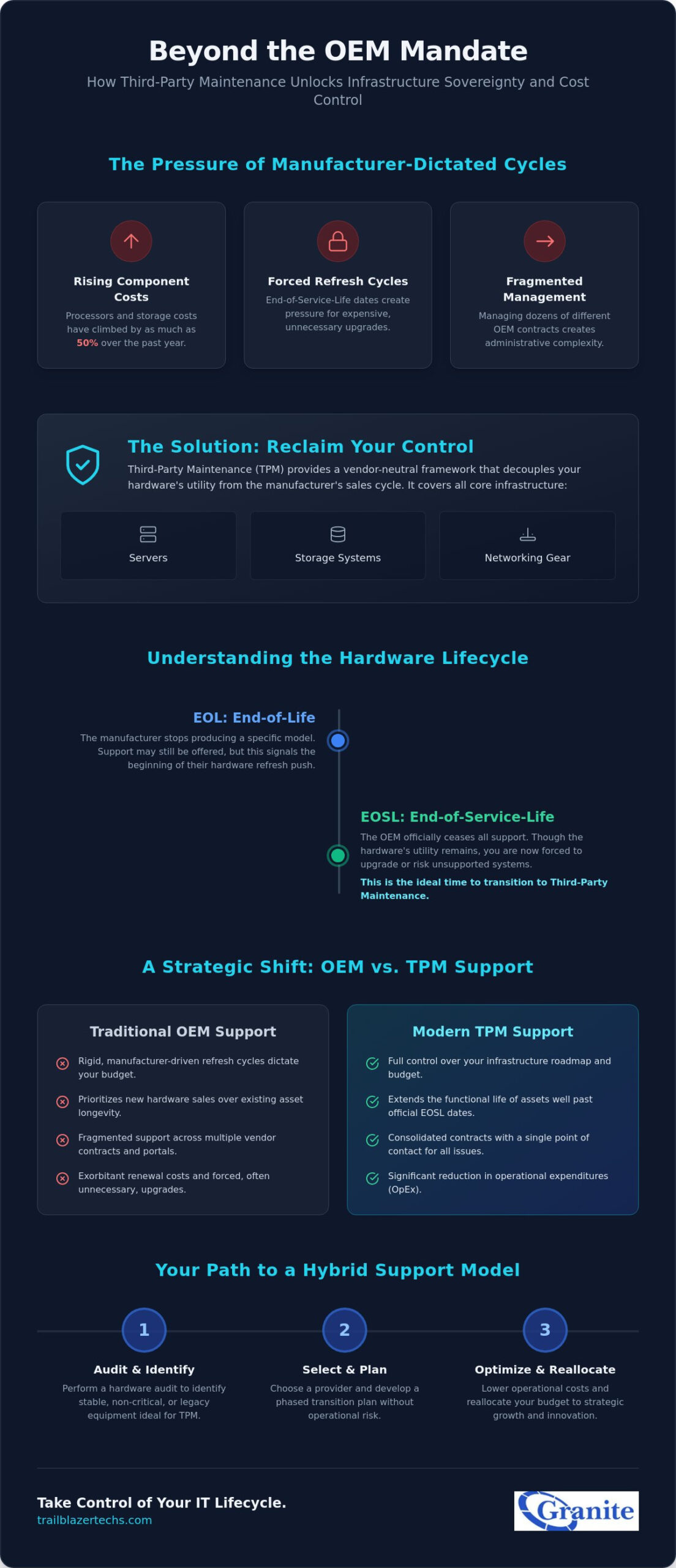
Third party hardware maintenance services provide an independent alternative to original equipment manufacturer (OEM) support contracts. This model allows Canadian enterprises to maintain their physical infrastructure through specialized providers rather than being restricted to the manufacturer’s own service ecosystem. By 2026, the shift toward vendor-neutral infrastructure management has become a standard practice for organizations looking to decouple their hardware utility from aggressive sales cycles. These services typically cover three primary hardware categories: servers, storage systems, and networking gear.
The move toward hybrid support models is driven by a need for greater flexibility and cost control. Organizations often maintain OEM support for the newest, most critical edge devices while transitioning stable, legacy assets to independent providers. Utilizing third party hardware maintenance services allows for a more methodical approach to hardware retirement, ensuring that assets are used until their true technical end. This approach is gaining momentum as the right to repair movement continues to influence Canadian policy and corporate procurement standards. It gives IT leaders the authority to decide when equipment is actually obsolete, rather than following a timeline dictated by a manufacturer’s quarterly revenue goals.
Understanding the TPM Ecosystem
Independent providers occupy a unique role in the enterprise IT lifecycle by offering a safety net for aging assets. It’s helpful to distinguish these providers from traditional managed service providers (MSPs). While an MSP typically focuses on the software layer, monitoring, and daily operations; a TPM provider is a specialist in physical break/fix logistics and spare parts management. The relationship between TPM and OEMs is often complementary rather than purely adversarial. Many organizations use these services to bridge the gap for equipment that the OEM no longer wishes to service, ensuring that the entire data center remains operational under a unified support strategy.
Key Industry Terminology: EOL and EOSL
Understanding the distinction between End-of-Life (EOL) and End-of-Service-Life (EOSL) is essential for effective asset management. EOL indicates that a manufacturer has stopped producing a specific model, though they may still offer support and parts. Manufacturers use these designations to signal the beginning of a hardware refresh cycle, often encouraging clients to upgrade long before the equipment has lost its technical value. EOSL is the specific point where OEM support ceases but the functional utility of the hardware remains intact. By recognizing these dates, IT leaders can plan transitions to third-party support before they’re forced into a capital-intensive hardware replacement. This proactive planning protects the budget from sudden, forced expenditures.
The Strategic Advantages of TPM Over OEM Support
Transitioning to third party hardware maintenance services offers a fundamental shift from rigid, manufacturer-driven cycles to a model based on actual equipment utility. Original equipment manufacturers (OEMs) often prioritize the sales of new hardware generations over the continued support of existing, functional systems. By choosing an independent provider, you gain direct control over your infrastructure roadmap. This decoupling allows Canadian IT departments to operate with a steady, solution-oriented focus, ensuring that technical complexity doesn’t dictate the annual budget. It’s a methodical approach that prioritizes foundational stability over forced upgrades.
One of the most immediate benefits is the consolidation of fragmented multi-vendor environments. Instead of managing a dozen different OEM contracts with varying expiration dates and support portals, you can integrate your entire data center under a single agreement. This simplification reduces administrative overhead and eliminates the “co-termination” complexity that often plagues large-scale operations. When you consider the future of third-party maintenance, it’s clear that this streamlined approach is becoming the standard for resilient IT architectures. It provides a single point of contact, which simplifies communication and accelerates resolution times when issues arise.
Cost Optimization and Budget Reallocation
The financial impact of this transition is significant. Organizations typically realize savings between 50 and 70 percent compared to standard OEM renewal rates. These aren’t just paper savings; they represent a meaningful reduction in OpEx that can be redirected toward high-impact projects like digital transformation or AI integration. By lowering the cost of maintaining stable legacy systems, you free up capital for the innovation that drives business growth. If you’re looking to optimize your current support structure, exploring third party maintenance options is a logical first step toward fiscal efficiency.
Lifecycle Extension and Sustainability
Extending the life of your hardware is both a financial and an environmental win. Forced capital expenditure for functional hardware is a common pain point when OEMs declare EOSL. Third party hardware maintenance services allow you to maintain high availability for these legacy systems as long as they serve your business goals. This approach significantly reduces e-waste and supports corporate sustainability mandates by keeping equipment in production longer. It’s a methodical way to ensure that your infrastructure remains a safe pair of hands for critical operations without the constant pressure of a refresh cycle. You gain the flexibility to retire equipment based on performance and business need rather than a manufacturer’s calendar.
Addressing Common Misconceptions and Risks
Concerns about technical proficiency often act as a barrier to adopting third party hardware maintenance services. It’s a common misconception that independent engineers lack the specialized knowledge found within OEM teams. In reality, the TPM sector is largely staffed by senior-level engineers who have spent decades working directly for major manufacturers. These professionals bring a wealth of cross-platform experience that is often broader than that of a single-vendor technician. They follow rigorous, standardized protocols to ensure that every repair or maintenance task is executed with methodical precision. This steady, grounded approach ensures that technical complexity is handled without the stress of manufacturer-driven timelines.
Managing parts logistics nationally requires a robust, nationwide network of depots. Reliable providers like TrailBlazer Techs maintain strategically located inventories of critical components to meet strict Service Level Agreements. This widespread presence allows for faster response times than many OEM field teams can provide, especially in areas beyond major urban centers. To mitigate risk, many enterprises adopt a tiered strategy. They keep mission-critical, “bleeding-edge” tech under OEM contracts while moving the bulk of their stable infrastructure to third party hardware maintenance services. This hybrid model balances the need for innovation with extreme cost efficiency.
The Truth About Technical Expertise
Independent providers rely on a deep bench of cross-trained talent to maintain high availability. These engineers aren’t just generalists; they’re specialists who understand the intricate interplay between different hardware layers. Because they aren’t bound by manufacturer sales targets, their focus remains entirely on the successful outcome of the repair. Standardized service delivery models ensure that whether your data center is in a bustling metropolitan area or a remote facility across the country, the quality of onsite technical labor remains consistent. This reliability is a cornerstone of the professional TPM approach, providing a safe pair of hands for your critical operations.
Navigating Firmware and Software Updates
The most frequent question involves access to proprietary firmware and software patches. It’s vital to identify which hardware actually requires constant updates. For mature, stable systems like storage arrays or core switches, firmware updates are rarely released after the first few years of the product lifecycle. For these “stable” assets, third-party support is an ideal fit. Recent shifts in right-to-repair legislation are also forcing manufacturers to be more transparent with documentation and tools. Organizations can legally maintain software compliance by purchasing specific licenses while using TPM for the physical break/fix support, ensuring a compliant and optimized environment.
Criteria for Evaluating a Third Party Maintenance Provider
Selecting third party hardware maintenance services requires a shift in focus from the financial terms of a contract to the physical realities of onsite execution. While an OEM might provide a global name, the quality of their local field service can vary significantly. A reliable partner must demonstrate a standardized approach to logistics, ensuring that technical expertise is available exactly where your hardware resides. This methodical evaluation ensures that your infrastructure remains a stable foundation for your business operations. It’s a process of verifying that the provider can act as a seasoned professional who prioritizes results over flashiness.
Transparency in contract management and SLA customization is equally vital. Avoid providers who offer rigid, “one-size-fits-all” agreements that mirror the inflexibility of OEM support. A high-level provider will offer tiered service levels, allowing you to match the response time to the criticality of the specific asset. This flexibility ensures that you aren’t overpaying for 4-hour response times on non-critical backup servers while maintaining rigorous protection for your primary production environment. Reviewing the provider’s history with specific storage systems and server architectures will reveal their true technical depth.
Logistics and Onsite Support Capability
Canada’s geography presents unique challenges for IT infrastructure management. A provider must have a verified nationwide reach to support multi-site enterprise deployments effectively. This includes robust “Remote Hands and Eyes” capabilities, which allow for local technical intervention without the need for your internal team to travel. Integrating onsite server maintenance services into your TPM strategy ensures that physical repairs are handled with the same rigor as high-level software management. You should verify the proximity of local parts depots to your critical facilities to guarantee that replacement components arrive within your required SLA windows.
Technical Depth and Infrastructure Knowledge
Technical competence extends beyond simple break/fix tasks. You should evaluate a provider’s expertise in the physical layer, including structured cabling services Canada, to ensure they understand how your systems are interconnected. A partner who understands the entire data center rack and stack can identify issues that a narrow hardware-only technician might miss. This “Reliable Architect” approach prioritizes foundational stability and follows rigorous protocols for every repair. When assessing technical depth in third party hardware maintenance services, look for specific certifications and a proven history of managing multi-generational hardware environments with methodical precision.
To ensure your infrastructure is managed with professional composure and technical precision, consider a third party maintenance assessment for your data center.
Integrating TPM into Your Infrastructure Strategy
Transitioning to third party hardware maintenance services is a methodical process that requires a clear understanding of your physical infrastructure. This integration isn’t a single event but a strategic shift that must be handled with professional composure to ensure zero disruption to critical operations. By adopting a structured framework, Canadian IT leaders can move away from manufacturer-dictated refresh cycles and toward a model based on actual equipment utility. It’s a path that prioritizes foundational stability while capturing significant budget efficiencies. This transition allows your team to regain sovereignty over the IT roadmap.
The success of this integration depends on a disciplined approach to project management. Many organizations fail when they attempt a “big bang” migration without assessing the specific needs of each asset. A seasoned professional understands that every piece of hardware has a different role in the business ecosystem. Therefore, the transition must be purposeful and tiered, ensuring that technical complexity is managed with precision. This steady, grounded approach lowers the stress of the migration by presenting infrastructure challenges as manageable tasks handled through rigorous protocols.
The Audit and Discovery Phase
The first step involves a thorough audit of all current hardware assets and their existing support status. You must identify high-cost OEM contracts that are nearing expiration, as these are prime candidates for conversion to third party hardware maintenance services. By mapping hardware criticality to appropriate service levels, you can ensure that your most vital systems receive the protection they require while secondary gear is optimized for cost. During this discovery phase, utilizing a wireless site survey is often beneficial to verify infrastructure connectivity and signal strength before any physical moves or hardware refreshes occur. This data-driven baseline prevents unforeseen connectivity issues during the transition.
Execution with Professional Composure
Moving from the audit to the execution phase requires specialized technical labor that is unfazed by technical complexity. TrailBlazer Techs provides the reliable architect persona needed to manage onsite hardware refreshes and maintenance with unwavering composure. We follow a phased implementation strategy, typically starting with non-critical or EOSL equipment to demonstrate the reliability of the support model before migrating primary production systems. This methodical progression builds trust through internal order and consistent results.
A seamless transition from OEM support relies on a partner who prioritizes results over flashiness. By leveraging experienced onsite technicians for tasks like racking and stacking or deskside support, you ensure that the physical layer of your data center remains a safe pair of hands for critical operations. The next step for any organization looking to secure its infrastructure is to partner with a specialist who values infrastructure stability and follows standardized protocols for every intervention. This focused approach ensures your IT environment remains a well-oiled machine, regardless of the hardware’s age.
Securing Your Infrastructure Sovereignty
Adopting a strategic approach to your data center allows you to move beyond the constraints of manufacturer-mandated refresh cycles. By integrating third party hardware maintenance services, you gain the flexibility to extend the functional life of your assets while significantly reducing operational expenditures. This transition ensures that your infrastructure remains a stable foundation for growth rather than a recurring capital burden. It’s a methodical way to reclaim control over your IT roadmap and redirect saved resources toward digital transformation.
Success in this transition requires a partner with proven technical depth and a disciplined approach to logistics. TrailBlazer Techs offers the professional composure and expertise needed to manage complex storage systems support and reliable project management for nationwide IT rollouts. With our nationwide onsite technical labor coverage, your critical systems remain in a safe pair of hands regardless of their location across Canada. Optimize your infrastructure with TrailBlazer Techs’ specialized technical services. We’re ready to help you build a more resilient and cost-effective technical foundation for the years ahead.
Frequently Asked Questions
Is third party hardware maintenance legal and compliant with OEM policies?
Third party hardware maintenance is entirely legal and does not violate OEM policies. Manufacturers are prohibited from voiding your warranty simply because you utilize an independent service provider for repairs or maintenance. This legal standing is reinforced by the growing momentum of right to repair legislation, ensuring that Canadian enterprises have the right to choose their own support partners without fear of manufacturer retribution.
How does TPM ensure parts availability for legacy storage systems?
Providers ensure parts availability through a robust network of local inventory depots stocked with both new and refurbished components. By maintaining their own supply chains, they often secure parts that the OEM has officially declared End-of-Life. This logistical independence allows for rapid replacement of critical components in legacy storage systems, often meeting or exceeding the response times of the original manufacturer.
Can I use TPM for mission-critical data center equipment?
You can certainly use third party hardware maintenance services for mission-critical equipment, provided the hardware is in a stable phase of its lifecycle. Many organizations adopt a hybrid strategy where they retain OEM support for the newest, most volatile systems while moving their mature, production-critical gear to a TPM model. This ensures high availability while capturing significant cost efficiencies across the data center.
What happens if a hardware failure requires a firmware update that only the OEM provides?
Access to proprietary firmware is one of the primary reasons to maintain a hybrid support model. If a system is in its initial release years and requires frequent patches, keeping it under OEM support is a prudent move. However, for mature systems where firmware has stabilized, the need for updates is minimal. In these cases, the physical maintenance and parts replacement provided by third party hardware maintenance services is the more logical choice.
How do TPM service level agreements (SLAs) compare to OEM Gold or Platinum support?
TPM service level agreements are designed to match or exceed the performance of OEM Gold or Platinum support. Providers offer identical response windows, such as 4-hour onsite or Next Business Day, but with greater flexibility in contract terms. Because TPM providers aren’t managing the overhead of a manufacturing business, they can often deliver these high-tier SLAs with more personalized attention and faster escalation paths.
Can a TPM provider handle nationwide rollouts and multi-site maintenance?
A qualified TPM provider is equipped to manage nationwide rollouts and multi-site maintenance through a distributed network of technical labor. This capability is essential for Canadian businesses with operations spanning multiple provinces. By utilizing a single point of contact for all locations, you simplify your administrative overhead and ensure that standardized protocols are followed at every facility, regardless of its remote nature.
What is the typical cost difference between OEM and third party maintenance?
The cost difference is substantial, with most organizations realizing savings between 50 and 70 percent compared to standard OEM renewal rates. These savings are achieved by removing the manufacturer’s high margins and focusing solely on the cost of technical labor and parts logistics. This reduction in OpEx allows IT leaders to reallocate funds toward innovation and digital transformation projects rather than basic infrastructure upkeep.
How do I transition from an OEM contract to a TPM provider without downtime?
Transitioning without downtime involves a methodical, phased approach that starts with a comprehensive hardware audit. You should begin by moving non-critical or legacy systems to the new provider to test their response times and technical proficiency. Briefly overlapping your contracts during the initial phase provides a safety net, ensuring a seamless handover of responsibilities before the OEM agreement officially expires.