
Your network infrastructure isn’t just a utility; it’s the invisible architect of your enterprise’s scalability. You likely understand the frustration of regional inconsistencies and the operational risk of unorganized server rooms. When you rely on fragmented structured cabling services Canada to manage national rollouts, the result is often technical debt that slows your 2026 digital initiatives. It’s a common challenge for leaders who need reliable performance across multiple provinces without the headache of managing dozens of local contractors.
By adopting a standardized national approach, you can transform this complexity into a “set and forget” asset. This strategy builds the resilient foundation your enterprise needs for scalable growth while ensuring minimal downtime. We’ll explore how to align your physical layer with the latest CSA C22.1 safety standards and TIA-568.0-E protocols to ensure seamless integration of AV, POS, and WiFi systems across all your Canadian locations. This methodical briefing provides the clarity you need to move from infrastructure maintenance to strategic optimization.
Key Takeaways
- Learn why treating your cabling as a 15-year strategic asset rather than a temporary fix prevents technical debt and supports long-term enterprise scalability.
- Understand the critical hierarchy of backbone and horizontal cabling to ensure your infrastructure meets the rigorous 2026 performance and safety requirements.
- Discover how a single point of contact for structured cabling services Canada eliminates the logistical friction of managing multiple regional contractors during national rollouts.
- Identify the methodical “Rack and Stack” protocols that optimize thermal efficiency and simplify physical asset management within high-density data centers.
- Explore a unified service model that integrates wireless site surveys and deskside support to create a resilient, “set and forget” infrastructure foundation.
The Strategic Role of Structured Cabling in Modern Enterprise
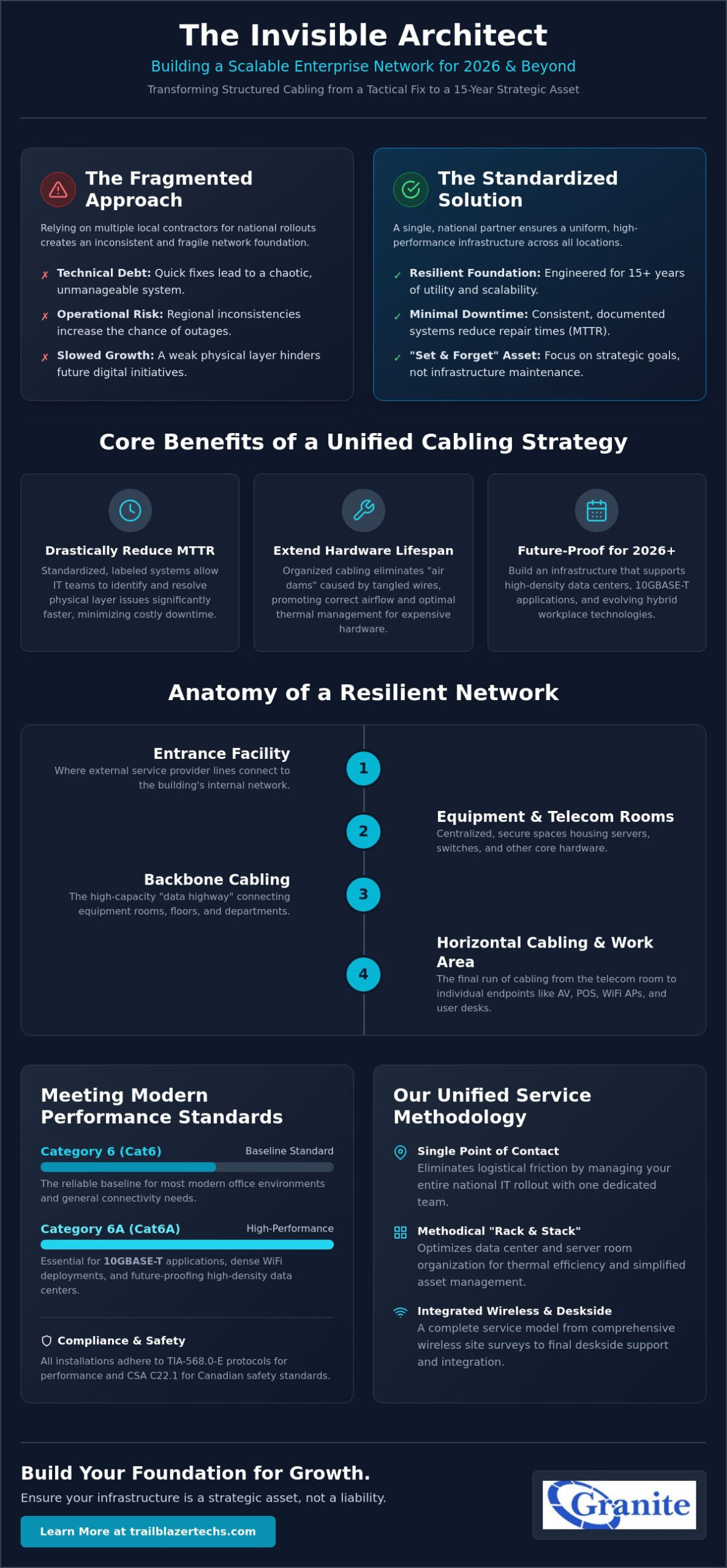
A robust structured cabling system serves as the foundational architecture for an enterprise’s entire digital operation. It is a comprehensive system of cabling and associated hardware that provides a standardized telecommunications infrastructure for data, voice, and video. Unlike the disorganized “spaghetti” wiring found in many older facilities, professional structured cabling services Canada focus on a methodical layout that ensures consistency across the board. This isn’t a temporary fix for immediate connectivity needs. It’s the nervous system of your office, and it must be engineered for 10 to 15 years of utility to support future technology cycles without requiring a total rip-and-replace.
By 2026, the industry has shifted toward high-density environments that place immense pressure on physical infrastructure. As servers and switches become more powerful, they generate more heat, making superior thermal management and precise cable organization essential for hardware health. Choosing an ad-hoc approach to wiring creates “technical debt,” a compounding burden where every quick fix makes the network more fragile. A professional structured approach eliminates this debt, replacing chaotic patches with a clean, documented, and manageable system that scales with your business.
The Business Case for Infrastructure Standardization
Standardization is a powerful tool for operational efficiency. When your cabling follows a logical, uniform pattern, internal IT teams can identify and resolve physical layer issues much faster. This directly reduces the mean time to repair (MTTR) and prevents small connection errors from turning into day-long outages. Furthermore, organized cabling prevents the “air dams” created by tangled wires, allowing cooling systems to function correctly and extending the lifespan of expensive rack-mounted hardware. The ROI of structured cabling is fundamentally defined by the significant reduction in network troubleshooting hours and the prevention of avoidable hardware failures.
Beyond Connectivity: Supporting the Hybrid Workplace
The modern Canadian office now functions as a high-tech hub for hybrid collaboration. This requires a backbone capable of handling constant high-definition AV streams and seamless video conferencing integration without lag. A well-planned structured cabling services Canada strategy also provides the necessary support for dense wireless access point (WAP) deployments, ensuring that mobile users have consistent signal strength throughout the facility. For organizations operating their own Canadian data centers, these low-latency connections are vital for real-time data processing and high-speed storage access. Investing in a professional physical layer ensures your workspace remains productive, regardless of how your team’s bandwidth needs evolve.
Technical Standards and Core Infrastructure Components
A structured cabling system follows a rigid hierarchy designed to eliminate network bottlenecks. It begins at the entrance facilities where external service provider lines interface with the building’s internal wiring. From there, the network flows through equipment rooms to the backbone cabling, which acts as the primary data highway between floors or departments. When deploying structured cabling services Canada, professionals prioritize this logical structure to ensure that a failure in one area doesn’t ripple through the entire national network. This methodical organization allows for easier troubleshooting and future-proofs the facility against evolving hardware requirements.
Horizontal cabling serves the individual workspaces, while backbone cabling provides the high-capacity links between telecommunications rooms. These components must adhere to ANSI/TIA-568 standards to guarantee that hardware from different manufacturers can communicate without friction. This low-voltage infrastructure is the foundation for modern smart buildings, enabling everything from automated climate control to advanced security sensors that require a stable, high-speed connection.
Copper Solutions: Cat6, Cat6A, and Beyond
Cat6 remains the baseline for most office environments, but Cat6A is increasingly necessary for 10GBASE-T applications that require higher bandwidth. In industrial settings with high electromagnetic interference, shielded (STP) cabling is essential to maintain signal integrity; unshielded (UTP) is typically sufficient for standard commercial spaces. To prevent signal degradation, installers must strictly follow the 90-meter horizontal link limit and utilize precise termination techniques that minimize crosstalk and return loss.
Fiber Optic Foundations for High-Speed Backbones
Vertical risers and campus-wide connections often require fiber optics to handle long distances and massive data throughput. Multimode fiber, specifically OM4 or OM5, is the standard for high-speed runs within a single building. Singlemode fiber is typically reserved for the extreme distances found in sprawling Canadian campus environments. All cabling installed in commercial air spaces must be plenum-rated (FT6) to comply with the National Building Code of Canada, ensuring fire safety and durability across the installation.
Integrated Technology Support: AV and POS
Modern executive boardrooms require specialized cabling to support integrated AV technology, including 4K video distribution and high-fidelity audio. Similarly, high-traffic retail environments depend on reliable Point of Sale (POS) infrastructure that can handle constant transaction data without interruption. High-performance structured cabling services Canada also account for Power over Ethernet (PoE) requirements, which provide both data and electricity to security cameras and smart lighting systems. If you’re planning a multi-site upgrade, consulting with experts in national rollouts ensures your technical standards remain consistent from coast to coast.
Executing Nationwide IT Rollouts with Consistency
Managing a national footprint across Canada introduces significant logistical friction. When an enterprise operates facilities across geographically diverse locations, maintaining quality control becomes a complex task. Relying on disparate local contractors often leads to inconsistent results and varying levels of performance. Utilizing professional structured cabling services Canada from a provider like TrailBlazer Techs provides a unified strategy that replaces regional variability with a single point of contact. This centralized project management ensures that your corporate standards are upheld regardless of the physical location of the branch or data center.
Consistency is built through rigorous documentation. When every server room is mapped and labeled according to the same industry standards, a technician in one corporate location can instantly understand the layout of a facility in another. This clarity is essential for post-installation support. If a hardware failure occurs, your “Remote Hands and Eyes” team can be directed with precision. This reduces the time spent on discovery and troubleshooting in remote Canadian facilities, turning a potential outage into a manageable task.
Standardized Deployment Frameworks
Establishing a “Universal Gold Standard” for rack layouts and labeling is the first step toward operational excellence. By implementing a centralized framework, enterprises typically see a reduction in deployment timelines by 20% to 30%. This efficiency stems from removing the guesswork for onsite technical labor. Every cable run and patch panel termination follows a pre-defined blueprint. This ensures local compliance with national corporate protocols and creates a predictable, repeatable process for every new site opening.
Logistics of Multi-Site Infrastructure
Coordinating a nationwide rollout requires synchronized logistics and methodical planning. Hardware staging and shipping must be timed to coincide exactly with the arrival of onsite technical teams. This precision minimizes storage costs and site disruption. In Canada, regional environmental factors also play a role in infrastructure longevity. Equipment rooms across varied environments may require specific climate-control considerations to protect sensitive low-voltage components from temperature fluctuations. Unified cabling standards simplify future nationwide hardware refreshes; the underlying infrastructure is already prepared for the next generation of technology. For enterprises planning a facility transition, a well-executed office relocation IT infrastructure strategy ensures your physical network layer is precisely re-architected to maintain full operational continuity from day one.
Optimizing the Data Center: Racking, Stacking, and Remediation
The physical layer of your data center requires a high level of methodical precision to function at peak performance. Racking and stacking is the professional process of physically installing servers, switches, and storage units into cabinets with a focus on accessibility and long-term maintenance. When these components are installed without a clear plan, the resulting “cable spaghetti” becomes more than an aesthetic nuisance; it represents a tangible security and operational risk. Tangled wires can lead to accidental disconnections during routine maintenance and, more importantly, they obstruct the airflow necessary for cooling high-density equipment. This is why leading structured cabling services Canada treat the physical arrangement of hardware as a critical component of thermal efficiency.
A disorganized server room is an invitation for downtime. If a technician can’t quickly identify a specific cable in an emergency, the mean time to repair (MTTR) increases significantly. Furthermore, excessive cabling bulk at the rear of a rack can trap heat, forcing cooling systems to work harder and increasing your energy costs. A professional approach to data center optimization ensures that every component is placed with intention, creating a stable environment where hardware can operate within its designed temperature parameters.
Precision Racking and Stacking
In a standard 42U cabinet, weight distribution is paramount for both safety and stability. Heavy UPS units and storage arrays should be placed at the bottom of the rack to lower the center of gravity. Proper equipment orientation is also required to implement hot-aisle/cold-aisle containment strategies, which direct exhaust heat away from sensitive intake fans. Detailed port mapping and labeling during the initial stack phase ensure that any future troubleshooting is straightforward. This organized approach allows your IT team to manage the environment with total confidence, knowing exactly where every connection leads.
Infrastructure Audits and Remediation
For organizations dealing with legacy infrastructure, a non-disruptive audit is the first step toward remediation. This process involves documenting every active connection and identifying underutilized ports without interrupting business operations. A “Communications Room Rescue” then transitions the environment from a state of chaos to a structured, labeled, and manageable space. Once the physical structured cabling services Canada are finalized, a wireless site survey can be conducted to optimize the placement of access points and eliminate dead zones created by previous interference. If your current server room is a source of stress, you can request a professional infrastructure audit to restore order and efficiency to your data center.
The TrailBlazer Techs Methodology: A Safe Pair of Hands
Reliability in infrastructure isn’t accidental; it’s the result of rigorous planning and a commitment to methodical precision. TrailBlazer Techs operates as the “Reliable Architect” for your critical business systems, ensuring that every wire, rack, and access point is positioned for maximum utility. Our end-to-end service model covers the entire lifecycle of your facility. We begin with comprehensive Wireless Site Surveys to establish a data-driven baseline, move through the physical installation of structured cabling services Canada, and conclude with the precise Racking and Stacking of your hardware assets. This unified approach eliminates the friction of managing multiple vendors and ensures a consistent standard across your entire national portfolio.
Choosing a national partner means gaining access to a specialized workforce capable of managing complex nationwide rollouts and ongoing third-party maintenance. We understand the logistical demands of the Canadian market, where a project in a remote facility requires the same level of detail as a headquarters in Toronto. By utilizing our Remote Hands and Eyes services, your central IT team can maintain control over distant assets without the need for constant travel. We provide the steady, grounded support necessary to keep your operations running smoothly, regardless of technical complexity.
Professional Composure in Technical Implementation
Our “Seasoned Professional” approach is designed to minimize the stress typically associated with large-scale IT projects. We act as an extension of your internal IT department, handling the heavy lifting of physical implementation so your team can focus on strategic goals. Our integrated service model combines traditional cabling with specialized support for AV Technology and Storage Systems Support, creating a single, cohesive infrastructure environment. Every project concludes with rigorous documentation and standardized reporting, providing you with a clear roadmap for future growth and maintenance.
Starting Your Infrastructure Transformation
The transition from a fragmented network to a standardized national asset begins with a clear assessment of your current state. Whether you’re planning new construction or a nationwide audit of existing facilities, we manage the entire process from initial design to the deployment of onsite technical labor. This methodical transition ensures that your infrastructure is compliant with the latest 2026 standards and ready for the demands of a high-density digital environment. If you’re ready to build a more resilient foundation, you can Contact TrailBlazer Techs for a professional infrastructure consultation and take the first step toward a “set and forget” infrastructure solution.
Building a Resilient Infrastructure for the Next Decade
Transforming your network into a standardized national asset eliminates the technical debt that often hinders enterprise growth. By aligning with 2026 standards and prioritizing methodical data center optimization, you ensure your organization remains agile and efficient. High-quality structured cabling services Canada provide the necessary consistency to manage complex multi-site environments without the typical regional friction or quality gaps. This methodical approach turns your physical layer into a “set and forget” foundation for future innovation.
TrailBlazer Techs provides specialized onsite technical labor for nationwide rollouts and proven expertise in high-density data center rack and stack. We bring a seasoned professional composure to complex AV and IT integrations, acting as a reliable architect for your most critical systems. It’s time to move beyond reactive maintenance and invest in an infrastructure that supports your long-term vision with unwavering stability. Secure your network foundation with TrailBlazer Techs nationwide services and build a foundation designed for excellence.
Frequently Asked Questions
What is the difference between structured cabling and conventional wiring?
Structured cabling is a standardized architecture based on international protocols, whereas conventional wiring typically involves ad-hoc, point-to-point connections. This organized approach utilizes specific subsystems like entrance facilities and backbone cabling to create a modular network. It’s designed to support multiple hardware uses over a long lifecycle; conventional wiring often leads to disorganized “cable spaghetti” and significant technical debt during hardware refreshes.
Why is Cat6A preferred over Cat6 for new Canadian office builds in 2026?
Cat6A is preferred because it supports 10Gbps data speeds at a full 100-meter distance, which is essential for 2026 enterprise bandwidth requirements. It also provides superior thermal management for high-wattage Power over Ethernet (PoE) applications. While Cat6 is sufficient for basic connectivity, Cat6A ensures your infrastructure can handle the high-density demands of modern smart buildings and advanced AV integrations without signal degradation.
How does structured cabling improve network security and uptime?
Structured cabling improves uptime by providing a clean, documented physical layer that reduces the risk of accidental disconnections. Organized cable management also facilitates better airflow, preventing hardware from overheating and failing prematurely. From a security perspective, a standardized layout makes it easier for IT teams to identify unauthorized physical connections and maintain strict control over the network’s entrance facilities and equipment rooms.
Can TrailBlazer Techs manage cabling projects across multiple Canadian provinces simultaneously?
Yes, we specialize in nationwide rollouts and can coordinate simultaneous structured cabling services Canada across all provinces and territories. Our centralized project management model provides you with a single point of contact, ensuring that corporate standards remain consistent from British Columbia to Newfoundland. This approach eliminates the logistical burden of managing multiple local contractors and guarantees that every facility adheres to the same rigorous technical protocols.
What is involved in a “Rack and Stack” service for a new data center?
Rack and Stack involves the methodical physical installation of servers, switches, and storage units into their designated cabinets. Our technicians handle the unboxing, mounting, and organized cabling of each component according to your specific port maps. This process includes precise labeling and cable dressing to ensure optimal airflow and ease of maintenance, turning a complex hardware delivery into a fully operational, structured environment.
How long does a typical commercial structured cabling installation take?
The duration of an installation depends on the scale of the facility and the number of data drops required. A small office fit-out might be completed in two to three days, while a multi-floor enterprise project or a large-scale data center deployment can take several weeks. We provide detailed timelines during the planning phase to ensure that onsite technical labor is synchronized with your overall construction or relocation schedule.
What are the benefits of a wireless site survey before installing data cabling?
A wireless site survey identifies the optimal placement for access points to ensure maximum signal coverage and minimal interference. By conducting this survey before finalizing your structured cabling services Canada, you can place data drops with precision. This proactive step prevents “dead zones” and ensures that your low-voltage infrastructure is perfectly aligned with the high-bandwidth needs of your mobile and hybrid workforce.
Does TrailBlazer Techs provide ongoing maintenance after the initial installation?
Yes, we provide comprehensive post-installation support, including deskside support, remote hands and eyes, and third-party maintenance. Our team is available to manage hardware refreshes, troubleshoot physical layer issues, and perform cabling remediation as your business needs evolve. This ongoing partnership ensures that your infrastructure remains a reliable, high-performing asset long after the initial rollout is complete.