
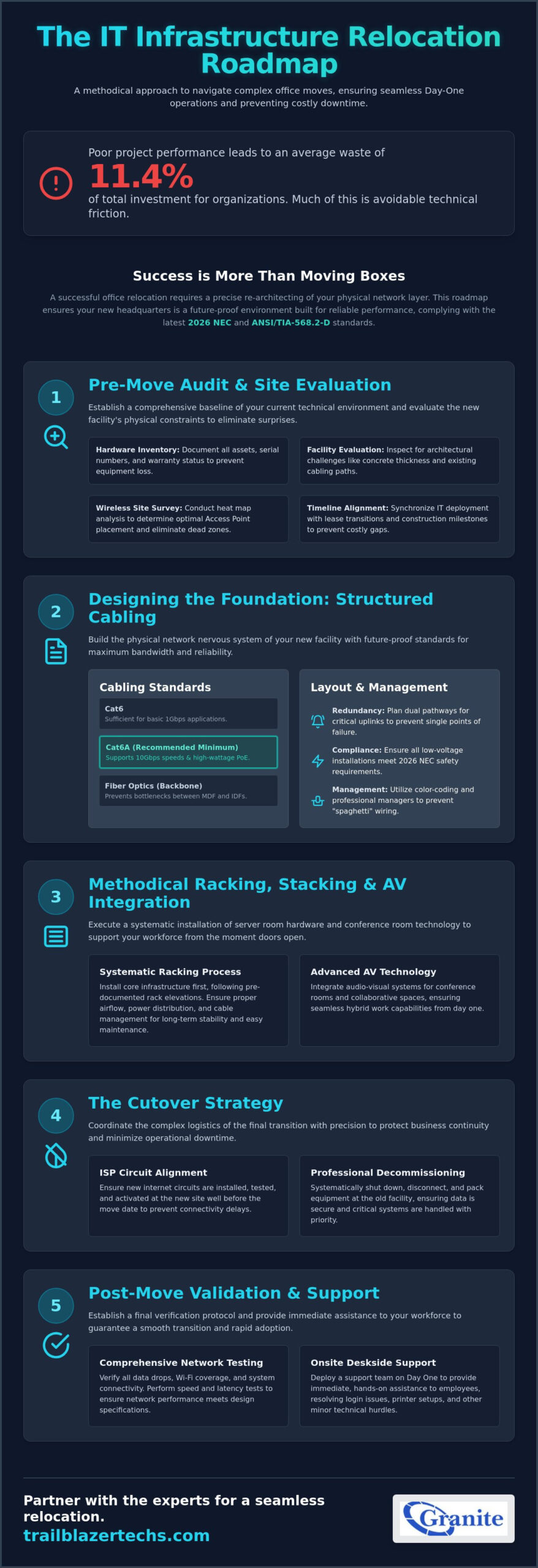
Organizations waste an average of 11.4% of their investment due to poor project performance, and for a major corporate move, these losses often stem from avoidable technical friction. Coordinating an office relocation IT infrastructure requires more than moving hardware; it demands a precise re-architecting of your physical network layer to prevent extended downtime. You likely recognize that the transition is only successful if your team is fully operational on day one, without the lingering frustration of connectivity gaps or poorly planned cabling layouts that lead to hidden long term costs.
We understand the pressure of managing multiple technical vendors while ensuring your new facility meets the latest 2026 NEC standards and ANSI/TIA-568.2-D requirements. This guide provides a methodical roadmap to navigate these complex logistics with professional composure and architectural precision. We will outline a structured deployment plan that covers everything from initial wireless site surveys to the final racking and stacking of your server room. This approach ensures your new headquarters is a future proof environment built for reliable performance and seamless day one operations.
Key Takeaways
- Conduct a rigorous pre-move audit and site evaluation to define your technical baseline and identify physical facility constraints early in the planning phase.
- Design a resilient office relocation IT infrastructure by selecting appropriate cabling standards and optimizing the placement of distribution frames for maximum bandwidth.
- Execute a systematic racking and stacking process that integrates advanced AV technology to support hybrid collaboration from the moment the doors open.
- Coordinate complex cutover logistics with precision, ensuring ISP circuit alignment and professional decommissioning to protect critical business continuity.
- Establish a post-move validation protocol that combines comprehensive network testing with immediate onsite deskside support for your workforce.
Pre-Move Infrastructure Audit and Site Evaluation
A seamless move requires a granular understanding of your current technical environment. You shouldn’t pack a single server before establishing a comprehensive baseline through a rigorous hardware inventory. This process defines what you own, its current performance level, and its role in your daily operations. By documenting every asset, you eliminate the risk of lost equipment or unexpected compatibility issues during the transition. It’s the only way to ensure the physical layer of your business remains intact.
Evaluating the new facility for physical constraints is equally critical. You need to inspect the new space for architectural challenges like concrete thickness or existing cabling paths that might conflict with modern structured cabling standards. This site evaluation allows you to identify opportunities for optimization, such as better server room placement or more efficient cable routing. Identifying mission-critical systems that require specialized handling, like high-capacity storage arrays, ensures these assets receive expedited migration and priority support. This methodical approach protects your office relocation IT infrastructure from the hidden costs of poor planning.
Timing is the final pillar of a successful audit. You should establish a clear timeline that aligns with your lease transitions and construction milestones. This ensures that your infrastructure is ready for deployment exactly when the physical space is accessible. It prevents the common pitfall of paying for a vacant office while waiting for network circuits to be activated. A well-timed move keeps your business moving without expensive gaps in productivity.
Conducting a Wireless Site Survey for the New Space
Connectivity is a utility, not a luxury. We perform a heat map analysis to identify potential dead zones within your new floor plan before furniture is installed. This survey determines the optimal placement for access points, accounting for building materials and potential signal interference. We ensure the wireless architecture is designed to handle high-density user requirements, providing consistent throughput for every employee on day one.
Inventory and Asset Management Protocols
Organization is the antidote to relocation chaos. Our protocols involve documenting all serial numbers, warranty statuses, and physical rack positions for every piece of hardware. We categorize equipment by sensitivity and priority, ensuring that core infrastructure moves first. This is also the ideal time to identify outdated hardware. It’s often more cost-effective to refresh aging gear rather than paying to relocate and re-install equipment that’s nearing its end-of-life.
Designing the Foundation: Structured Cabling and Low Voltage
The physical cable plant is the nervous system of your new facility. Selecting the right standard is the first step in building a resilient office relocation IT infrastructure. While Cat6 remains sufficient for some basic applications, Cat6A is the recommended minimum for 2026 to support 10Gbps speeds and high-wattage Power over Ethernet (PoE) demands. For the backbone connecting your Main Distribution Frame (MDF) to Intermediate Distribution Frames (IDF), multi-mode or single-mode fiber optics provide the necessary bandwidth to prevent bottlenecks between floors or departments. This foundational layer must be installed with precision to support the high-density data requirements of modern enterprise operations.
A well-architected layout prioritizes both accessibility and redundancy. By planning dual pathways for critical uplinks, you ensure that a single cable failure doesn’t isolate an entire wing of the office. We also ensure that all installations comply with the 2026 National Electrical Code (NEC) and Canadian Electrical Code standards. These regulations now require limited-energy systems to meet stricter general safety requirements. For businesses seeking a partner to manage these technical complexities, our team provides expert structured cabling solutions tailored to modern enterprise needs. This methodical approach ensures your new space is safe, compliant, and ready for day one.
The Importance of Proper Cable Management
Professional cable management prevents the “spaghetti” wiring that often plagues poorly planned server rooms. We utilize both vertical and horizontal cable managers to maintain clear pathways and protect the physical integrity of every run. Color-coding cables by function, such as blue for data and red for security, allows for rapid troubleshooting during maintenance. We provide a comprehensive cable map to ensure future onsite technical support is efficient and accurate.
Future-Proofing Your Low Voltage Infrastructure
Structured cabling is the standardized architecture for telecommunications. To account for future growth, we recommend installing additional drops in high-traffic areas and flexible workspaces. Integrating PoE throughout the plant enables you to power VoIP phones, security cameras, and IoT sensors without needing separate electrical outlets. This foresight ensures your infrastructure remains relevant as your technology stack evolves over the coming years, saving you from the high costs of retrofitting later.
Methodical Racking, Stacking, and AV Integration
Once the foundation of structured cabling is in place, the focus shifts to the physical deployment of your hardware. A methodical approach to racking and stacking ensures that every server, switch, and storage array is positioned for maximum efficiency and accessibility. We follow a pre-designed layout to optimize the use of vertical space while maintaining clear pathways for future maintenance. This phase of your office relocation IT infrastructure project requires strict adherence to manufacturer specifications for mounting and grounding. Proper grounding is particularly vital under the 2026 National Electrical Code (NEC) updates, which have integrated communication system requirements into broader safety chapters to prevent electrical hazards in high-density environments.
High-density server racks in 2026 demand significant power and cooling capacity to support AI-driven workloads and advanced data center systems. We verify that your facility’s HVAC systems can handle the thermal load generated by your specific hardware configuration. We also confirm that electrical circuits provide sufficient amperage for redundant power supplies, creating a resilient environment that prevents hardware degradation. This rigorous verification process is a core component of a successful office relocation IT infrastructure, as it mitigates the risk of unplanned downtime caused by environmental failures.
Server Room and Data Center Deployment
Thermal management is the priority during the physical installation process. We organize racks to support hot and cold aisle containment, which improves cooling efficiency and reduces energy consumption. We also install Uninterruptible Power Supplies (UPS) to protect your assets from the voltage fluctuations common during building transitions. Every port and power connection is clearly labeled according to industry standards. This level of organization allows for efficient remote hands and eyes support in the future, as onsite technicians can quickly identify and service specific components without confusion.
Integrated AV and Conference Room Setup
Modern collaboration requires an equitable experience for both onsite and remote participants. We mount high-resolution displays and configure AV technology to ensure consistent user experiences across all huddle rooms and boardrooms. Our team verifies connectivity for integrated video conferencing platforms, ensuring that AI-driven cameras and microphones function correctly within the new network environment. We also ensure all systems comply with the April 24, 2026, digital accessibility standards, providing inclusive communication tools for all users. We test every input and control system before your employees arrive to guarantee that technology facilitates work rather than hindering it on day one.
The Cutover Strategy: Managing Multi-Site IT Project Logistics
The cutover window represents the peak of technical risk during any transition. It’s not just about turning on new equipment; it’s about the precise synchronization of decommissioning at the old site and activation at the new one. Coordinating with Internet Service Providers (ISPs) is the primary hurdle here. You must ensure circuit activation at the new facility aligns perfectly with your move date to avoid expensive work stoppages. We deploy onsite technical labor to manage the physical decommissioning at your legacy site, ensuring that assets are handled with the same care during removal as they were during their initial installation. For complex moves, a phased migration strategy for multi-site organizations helps minimize risk by isolating potential issues to specific locations rather than the entire enterprise.
To manage this complexity, we establish a central “war room” for the duration of the transition. This dedicated hub serves as the single source of truth for real-time communication during the cutover window. It allows project managers to monitor progress, address technical bottlenecks immediately, and ensure all stakeholders remain informed as milestones are met. For organizations managing expansive growth across various provinces, our nationwide rollouts provide the logistical framework needed to maintain consistency across every new branch or office. This structured oversight ensures that your office relocation IT infrastructure is deployed without the typical fragmentation seen in uncoordinated, localized moves.
Nationwide IT Rollout Coordination
Standardization is the key to managing multi-site logistics with professional composure. We develop uniform deployment protocols that every regional field technician must follow, ensuring that a server rack deployed in one operational hub looks and functions exactly like one in any other site within your network. A central project management team oversees these regional efforts, synchronizing the arrival of hardware with the availability of technical labor. This prevents costly delays where technicians are onsite without the hardware they need to install, or equipment sits unsecured in a construction zone.
Contingency Planning for Zero Downtime
Reliability depends on preparing for the unexpected. We recommend maintaining a backup internet connection, such as a redundant 5G or secondary fiber circuit, during the initial transition period to protect against ISP delays. A formal rollback plan is also essential; it provides a clear path to restore services at the original location if a critical system failure occurs during the cutover. Throughout the relocation weekend, we schedule “Go/No-Go” checkpoints. These are predefined moments where the team evaluates progress against technical milestones to decide whether to proceed or pivot, ensuring no move continues past a point of unrecoverable failure.
Post-Move Validation and Deskside Support
The physical installation of your hardware is a significant milestone, but the relocation project isn’t truly complete until every system is validated in its new environment. Post-move validation is the final safeguard that ensures your office relocation IT infrastructure meets the performance benchmarks established during the design phase. We perform rigorous end-to-end testing of every network drop and wireless access point to confirm that the physical layer is perfectly aligned with your logical network requirements. This phase includes a final audit to reconcile all hardware against the initial inventory, ensuring that every asset is accounted for, functional, and properly documented in its new location.
Once the network is verified, the focus shifts to the long-term stability of your facility. Transitioning to a structured third party hardware maintenance services strategy allows you to maintain the integrity of your new environment without taxing your internal resources. This proactive approach ensures that your infrastructure remains optimized long after the move-in date. It provides a reliable framework for ongoing hardware support, lifecycle management, and emergency repairs. By establishing these protocols now, you protect the investment made during the relocation and ensure a consistent operational baseline for your Canadian enterprise.
Network Infrastructure Audits and Performance Testing
Testing must go beyond simple connectivity checks. We validate throughput speeds and latency across the entire cable plant to ensure that bandwidth-heavy applications perform as expected. This audit also confirms that all security systems, including IP cameras and access control readers, are fully operational and integrated with your monitoring platform. Our validation process includes several critical checkpoints:
- Signal Strength Verification: Confirming wireless coverage meets the density requirements identified in the initial site survey.
- Throughput Validation: Testing Cat6A and fiber runs to ensure they meet 10Gbps performance standards.
- Redundancy Testing: Verifying that failover systems and UPS backups activate correctly during power fluctuations.
At the conclusion of this process, we provide a final as-built documentation package. This comprehensive resource serves as the technical blueprint for your new space, allowing your internal IT team to manage the environment with total clarity.
Onsite Technical Support for the “First Day” Experience
The first day in a new office is often the most stressful for employees. To mitigate this, we deploy technicians for dedicated deskside support to handle the “last mile” of the move. Our team provides immediate assistance with peripheral connectivity, docking station issues, and monitor configurations. We verify that all shared resources, such as printers and scanners, are correctly mapped and accessible from every workstation. This white-glove service ensures that connectivity gaps don’t hinder productivity, allowing your staff to focus on their work while we handle the technical nuances of their new setup.
Securing Operational Excellence in Your New Facility
A successful transition depends on viewing your physical move as a strategic opportunity to modernize your technology stack. By prioritizing a rigorous pre-move audit and a certified foundation of cabling, you eliminate the risks of extended downtime and hidden infrastructure costs. You’ve seen how methodical racking and a synchronized cutover strategy protect your business continuity. These steps ensure that your technical assets aren’t just moved; they’re optimized for the high-density demands of 2026.
Managing a complex office relocation IT infrastructure requires a partner with proven competence and a standardized approach to technical logistics. We offer comprehensive structured cabling certifications and specialized expertise in high-density rack and stack services to ensure your server room is built for long term stability. With our nationwide technical labor coverage across Canada, you can rely on consistent, professional support regardless of your location. Partner with TrailBlazer Techs for your next office relocation to ensure your team is productive from the first hour of day one. Your new office is ready to become a powerful engine for your organization’s growth.
Frequently Asked Questions
How early should we start planning the IT infrastructure for an office move?
You should begin planning your office relocation IT infrastructure at least four to six months before your scheduled move date. This lead time is necessary to conduct thorough site evaluations and coordinate with Internet Service Providers. In many Canadian markets, circuit installations can require several months of lead time, so early engagement prevents your team from moving into a facility without active connectivity.
What is the difference between structured cabling and regular network wiring?
Structured cabling is a standardized architecture for telecommunications that uses specific components and layouts to create a unified network. Regular network wiring often involves point-to-point connections that lack a formal hierarchy or organization. A structured approach utilizes patch panels and distribution frames to ensure your network is scalable, manageable, and compliant with industry standards like ANSI/TIA-568.2-D.
Do we need a new wireless site survey if we are moving to a similar-sized office?
Yes, a new wireless site survey is essential because signal propagation depends on building materials and architectural layouts rather than just square footage. Concrete density, glass partitions, and even the placement of HVAC ducting in the new space will impact signal strength. A survey identifies these variables to ensure access points are positioned for optimal coverage and high-density user support.
How can we minimize network downtime during a nationwide IT rollout?
Minimizing downtime during a nationwide rollout requires a phased migration strategy and the use of standardized deployment protocols. By utilizing a central project management team to oversee regional field technicians, you ensure that every location follows the same rigorous schedule. This coordination synchronizes equipment arrival with technical labor, preventing the delays that occur when hardware is onsite without an installer.
What are the risks of using internal staff for server racking and stacking?
Using internal staff for racking and stacking increases the risk of physical hardware damage and improper thermal management. Professional technicians are trained to follow manufacturer specifications for weight distribution and grounding, which are critical for high-density server environments. Improper installation can lead to hardware failure, voided warranties, and inefficient airflow that increases your long-term energy costs.
How does structured cabling impact long-term network maintenance costs?
A standardized office relocation IT infrastructure utilizing structured cabling reduces long-term maintenance costs by simplifying troubleshooting and future upgrades. Organized cable plants allow onsite technical support teams to identify and resolve connectivity issues quickly, which lowers labor expenses. This organized foundation also prevents the need for expensive retrofitting when your organization decides to adopt new hardware or higher bandwidth standards.
What technical labor is required for a successful office technology relocation?
A successful relocation requires a specialized team including certified cabling installers, network engineers, and deskside support technicians. You also need logistical coordinators who can manage the decommissioning of assets at the old site and their re-installation at the new facility. For multi-site organizations, having access to nationwide technical labor ensures that the same quality of work is performed across every branch.
Can AV technology be integrated during the initial cabling phase?
Integrating AV technology during the initial cabling phase is the most efficient way to ensure a seamless collaboration experience. By planning for displays, microphones, and cameras while the structured cabling is being installed, you can ensure all data and power requirements are met behind the walls. This approach eliminates the need for visible wires or expensive post-construction modifications once your team has occupied the space.