What if the most expensive component of your 2026 infrastructure strategy isn’t the hardware itself, but the cost of flying a senior engineer across Canada for a routine hardware swap? Many enterprise IT leaders find that maintaining a physical presence at every distributed site is no longer sustainable as travel expenses rise and technical requirements become more complex. Utilizing professional remote hands data center support allows your organization to address onsite requirements immediately without the logistical burden and high cost of constant travel.
You likely agree that your internal team’s time is better spent on high-level architecture than on the road. This article shows you how to optimize your uptime and reduce operational overhead by leveraging professional support across your national footprint. We’ll examine the shift toward standardized support models and provide a framework for managing your critical assets with methodical precision, ensuring your hardware remains stable and your service quality stays consistent across every location.
Key Takeaways
- Modernize your infrastructure strategy by understanding how onsite technical labor has evolved from simple reboots to complex management of high-density AI environments.
- Distinguish between basic tasks and advanced technical interventions to choose the most cost-effective tier of remote hands data center support for your national facilities.
- Quantify the operational value of third-party support by comparing internal travel expenses and staffing costs against the efficiency of localized, badged engineers.
- Implement rigorous selection standards for providers, focusing on standardized ticketing systems and verified technical expertise to maintain consistent service quality across Canada.
- Shift your focus from reactive troubleshooting to proactive infrastructure stability by leveraging a partner who applies methodical precision to every onsite task.
The Evolution of Remote Hands Data Center Support in 2026
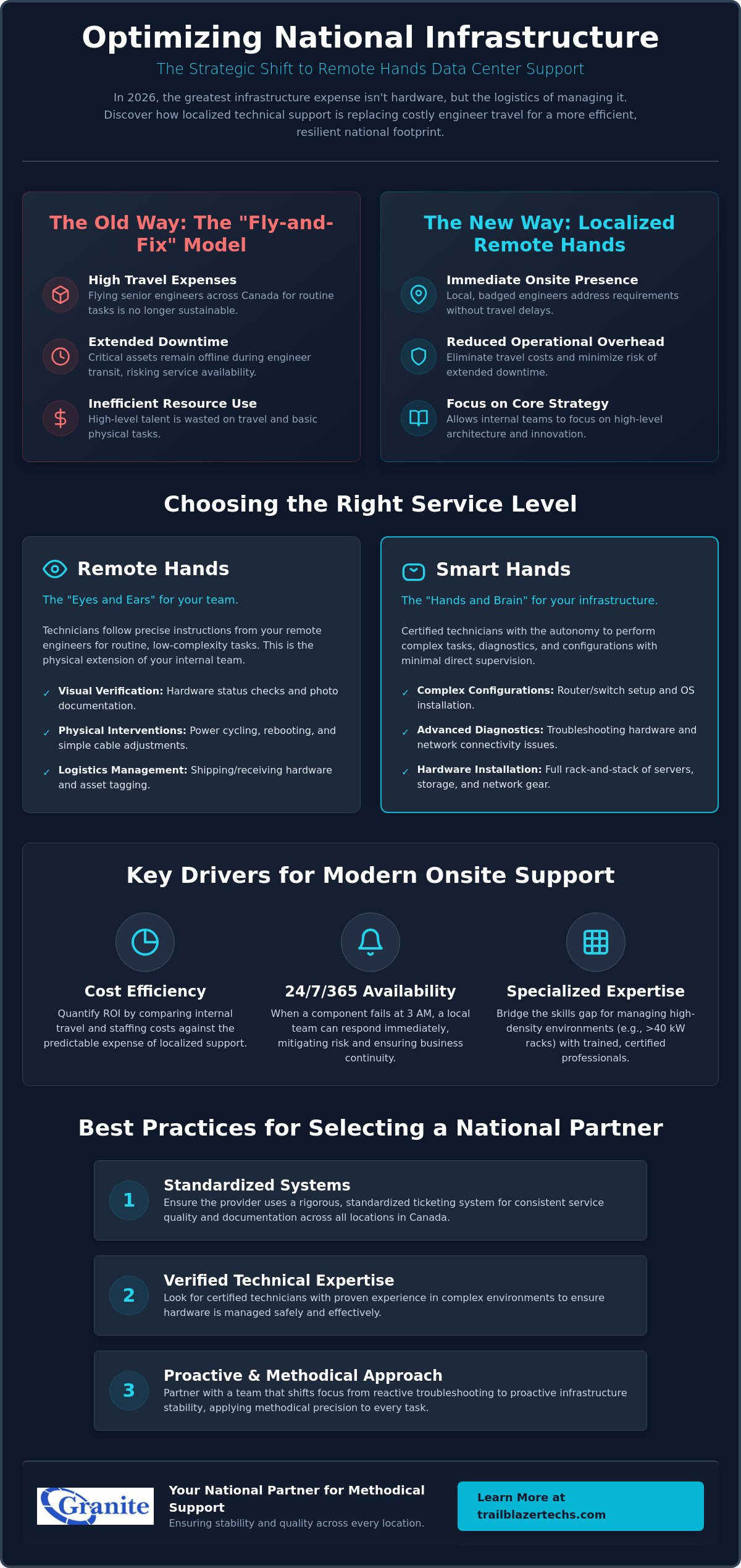
Remote hands data center support is the provision of on-demand, onsite technical labor to perform physical maintenance and troubleshooting within a data center environment. While historically viewed as a simple utility within a colocation centre, the role has transformed significantly by 2026. Today’s technicians don’t just flip switches; they act as the local execution arm for complex, software-defined infrastructure. As data centers evolve to support high-density AI workloads, the physical layer has become more specialized, requiring a methodical approach that goes far beyond basic reboots.
Enterprise leaders across Canada are moving away from the traditional “fly-and-fix” model for their remote sites. Sending a senior engineer from a central hub like Toronto to a facility in Halifax or Vancouver for a routine hardware swap isn’t commercially viable. It’s inefficient. High travel costs, combined with the risk of extended downtime during engineer transit, make localized remote hands data center support a strategic necessity. By leveraging professional onsite labor, organizations maintain high-availability standards for national networks without the logistical burden of relocating internal staff for every physical intervention.
Key Drivers for Outsourced Data Center Support
The shift toward outsourced support is driven by several economic and technical factors. Rising travel expenses and the environmental impact of frequent flights are primary concerns for Canadian enterprises focused on ESG compliance. Additionally, the global economy demands 24/7/365 availability. When a critical component fails at 3:00 AM, waiting for an internal team to arrive is a risk most businesses can’t afford. There is also a growing skills gap at the physical layer. As server racks now frequently exceed 40 kW densities, the expertise required to manage high-performance cooling and power systems is increasingly specialized. Professional remote hands teams bridge this gap by providing standardized, expert care at the rack level.
Standard Tasks Covered by Remote Hands
Modern support services provide a steady, reliable presence for a variety of critical onsite tasks. These services ensure that your infrastructure remains stable and documented, even when your primary team is thousands of kilometers away. Standard tasks typically include:
- Visual verification: Technicians perform hardware status checks and provide high-resolution photo documentation of equipment and environmental conditions.
- Physical interventions: This includes power cycling, rebooting servers, and making precision adjustments to structured cabling.
- Logistics management: Support teams handle the intake of new hardware, inventory tagging, and the secure shipping and receiving of IT assets.
By delegating these tasks to a trusted partner, you ensure that your physical infrastructure is managed with the same level of precision and care as your software stack. This structured approach to remote hands data center support allows your internal engineers to focus on high-level architecture and optimization rather than the logistics of site visits.
Remote Hands vs. Smart Hands: Which Service Level is Required?
Understanding the technical threshold between basic and advanced onsite labor is critical for maintaining operational efficiency in a modern infrastructure. While the industry often uses these terms interchangeably, they represent distinct service tiers with different cost structures and skill requirements. Selecting the appropriate level ensures that your remote hands data center support budget is utilized effectively without compromising the safety or performance of your hardware. The distinction fundamentally rests on the degree of autonomy and technical expertise required to complete a task successfully.
Remote hands support is typically categorized as the “eyes and ears” of your data center operations. This service level focuses on routine, low-complexity tasks where a technician acts as a physical extension of your remote engineering team. Conversely, Smart Hands acts as the “hands and brain” for your infrastructure. These technicians possess the technical proficiency to perform complex configurations, diagnostics, and installations with minimal direct supervision. Choosing the correct tier allows you to avoid overpaying for senior engineering time when a simple physical intervention is all that’s required.
Remote Hands Service Scope
The tasks within this scope are generally procedural and follow a strict “Problem-Action-Result” flow. Technicians perform basic physical actions based on explicit instructions provided by your central NOC or lead engineers. This includes pushing buttons to initiate a hard reset, toggling power switches, and checking indicator lights to confirm equipment status. A common application of Remote Hands Service involves basic structured cabling services Canada checks, such as verifying that a patch cord is properly seated or replacing a damaged cable in a pre-labeled port. These technicians also serve a vital security function by escorting third-party vendors and observing onsite work to ensure compliance with your corporate protocols.
Smart Hands Service Scope
This higher tier of support is necessary for projects that involve architectural changes or complex troubleshooting. Smart Hands technicians are capable of executing equipment racking and stacking according to detailed elevation diagrams, ensuring that weight distribution and airflow management meet 2026 standards. Their responsibilities often extend to OS installations, firmware updates, and advanced hardware diagnostics that require a local console connection. In high-density environments, these specialists perform fiber optic testing and manage sophisticated cable pathways to prevent signal degradation. By utilizing a tiered model for remote hands data center support, you maintain a methodical approach to infrastructure management while keeping costs predictable. For enterprises managing distributed assets, a partner providing nationwide technical support ensures the right expertise is deployed for every ticket, from simple reboots to complex system deployments.
Evaluating the ROI: In-House Teams vs. Managed Remote Support
Determining the true return on investment for infrastructure management requires looking beyond the line item of a monthly service fee. Many enterprise leaders initially consider internal staffing to be the safer option, yet they often overlook the total cost of ownership associated with the physical layer. Managed remote hands data center support provides a predictable cost structure that eliminates the volatility of emergency travel and the administrative burden of internal training. By shifting to a professional service model, organizations can quantify their operational spend with precision while ensuring that critical assets receive expert attention without delay.
The “Time-to-Site” metric is perhaps the most significant indicator of ROI in a high-availability environment. When a hardware failure occurs in a distributed facility, the cost of downtime accumulates every minute an engineer is in transit. Localized third-party support accelerates incident resolution by placing badged technicians within driving distance of your equipment. Beyond speed, this model serves as a vital risk mitigation strategy. It reduces the liability of utilizing untrained local staff or “best-effort” contractors who may not follow rigorous data center protocols. Understanding What is Remote Hands? reveals how these standardized services protect your infrastructure from the human error often associated with uncoordinated onsite interventions.
The Cost of Internal Engineering Travel
Relying on a “fly-and-fix” strategy for national infrastructure is inherently inefficient. When you calculate the true cost of airfare, lodging, and ground transportation for a simple server migration, the financial impact often exceeds the cost of the hardware itself. There is also a significant opportunity cost to consider. Your senior engineers are hired to focus on high-level architecture and strategic optimization, yet these projects are ignored while they spend hours in transit to perform routine physical tasks. Organizations that shift to a national field service model realize significant savings by replacing variable travel expenses with a fixed, predictable cost structure for onsite technical labor.
Scalability for Nationwide Rollouts
Executing a simultaneous hardware refresh across 50 locations in Canada is a logistical challenge that can overwhelm even the most robust internal teams. Managed remote hands data center support allows for rapid scalability that internal hiring cannot match. By leveraging a single point of contact for national infrastructure management, you ensure that documentation, reporting, and installation standards remain consistent from coast to coast. This methodical approach ensures that every site rollout follows the same architectural diagrams and security protocols, providing a unified view of your distributed assets without the need to manage dozens of individual local vendors.
Best Practices for Selecting a National Remote Hands Provider
Selecting a provider for remote hands data center support requires more than a simple price comparison. It’s a strategic decision that impacts the foundational stability of your national infrastructure. A reliable partner must demonstrate a commitment to professional composure and technical rigor, ensuring that onsite tasks are executed with methodical precision. When evaluating potential candidates, prioritize those who utilize badged engineers and maintain a verifiable record of technical certifications. This ensures that the individuals accessing your critical equipment possess the necessary expertise to follow complex protocols without the need for constant oversight.
Geographic reach is a critical factor for Canadian enterprises with distributed assets. Your provider should offer consistent service quality across major urban centers and rural edge locations alike. Whether your hardware is located in a primary hub or a remote industrial site, the level of support should remain standardized. Security and compliance are non-negotiable in the 2026 landscape. Verify that your partner adheres to SOC2 and HIPAA standards and follows strict physical access protocols to protect your data and hardware from unauthorized interference.
The Importance of Methodology and Composure
In the high-stakes environment of a data center, a “steady hand” is significantly more valuable than “fast hands.” Mistakes made in haste lead to avoidable downtime. Your provider must utilize standardized racking and stacking procedures that prioritize airflow management and structural integrity. Every task, no matter how minor, should follow a pre-approved Statement of Work (SOW). This structured approach ensures that onsite technicians work within defined parameters, reducing the risk of improvised solutions that could jeopardize system stability.
Reporting and Transparency Requirements
Reliability is built through transparency. A professional provider delivers real-time updates and high-resolution photographic evidence of completed tasks, allowing your remote team to verify the quality of work immediately. Look for partners who offer seamless integration with your enterprise ticketing systems to maintain a unified workflow. Post-incident reporting and root cause analysis (RCA) support are also essential for long-term optimization. These reports provide the data necessary to identify recurring issues and improve your infrastructure’s overall resilience. For organizations seeking a partner that combines technical expertise with a nationwide footprint, consider how professional remote hands and eyes services can streamline your distributed operations.
TrailBlazer Techs: Your National Partner for Methodical Support
TrailBlazer Techs serves as the Reliable Architect for your distributed enterprise infrastructure. We provide a steady, professional presence that remains unfazed by technical complexity. Unlike many providers who focus exclusively on their own proprietary facilities, we offer facility-agnostic remote hands data center support across the entire country. This ensures your team receives the same high standard of care whether your hardware resides in a major carrier hotel or a private onsite server room. We act as a professional extension of your organization, applying a solution-oriented approach to every physical intervention.
Our commitment to professional composure ensures that every onsite task is handled with methodical precision. We manage nationwide rollouts by implementing standardized protocols that eliminate the variability often found in local field services. By acting as a single point of coordination, we ensure that your infrastructure remains stable and secure through every phase of its lifecycle. This rhythmic consistency in our service delivery builds trust, as our structured approach to technical work mirrors the high standards of the enterprises we support.
Integrated Infrastructure Solutions
We provide a comprehensive suite of services that extends beyond traditional remote hands data center support. Our teams integrate structured cabling, racking and stacking, and AV technology into a unified service model. This holistic approach allows us to manage complex requirements, such as the maintenance of high-capacity storage systems, with the same level of detail as a simple reboot. We also conduct thorough wireless site surveys and network audits to provide a complete picture of your physical layer performance. Every service we offer is designed to reinforce the foundational stability of your national network.
Get Started with TrailBlazer Techs
Managing national infrastructure shouldn’t be a source of organizational stress. We reduce the burden on your internal staff through proven competence and a serious-minded dedication to technical excellence. Our consultation process allows us to build customized support agreements that align with your specific uptime requirements and budgetary constraints across Canada. By partnering with a specialist who values infrastructure and logistical precision, you secure a safe pair of hands for your most critical business operations. We invite you to experience the reliability of a partner who treats your infrastructure with the care it deserves.
Contact TrailBlazer Techs for Reliable Onsite Support
Building a Resilient Infrastructure Strategy
Ensuring the stability of your physical layer is a fundamental requirement for any enterprise operating a national network. Transitioning from a reactive travel model to a structured support framework allows your senior engineers to focus on high-level strategy while onsite tasks are handled with expert precision. By clearly defining service tiers, you maintain operational efficiency and keep costs predictable across your entire footprint.
Professional remote hands data center support provides the unwavering reliability needed to manage complex 2026 infrastructure. TrailBlazer Techs delivers specialized onsite technical labor with professional composure, offering nationwide coverage that ensures seamless multi-site rollouts. Our expertise in structured cabling and racking and stacking provides a solid foundation for your most critical assets. It’s time to replace logistical stress with the quiet authority of a seasoned partner.
Secure Your Infrastructure with TrailBlazer Techs Onsite Support
Your infrastructure is too vital to leave to chance. We look forward to helping you build a more stable and efficient future for your distributed data center operations.
Frequently Asked Questions
What is the difference between remote hands and smart hands?
Remote hands services focus on basic physical tasks where a technician follows your specific instructions. This includes power cycling servers or verifying indicator lights. Smart hands involves a higher level of technical autonomy and expertise. These specialists perform complex configurations, firmware updates, and advanced troubleshooting that require a deeper understanding of the equipment’s operational logic.
Can remote hands technicians help with server rack migration?
Yes, professional onsite support includes comprehensive racking and stacking services essential for migrations. Technicians manage the physical de-installation and re-installation of hardware according to your elevation diagrams. This methodical approach ensures that weight distribution and airflow management meet 2026 standards. It’s a reliable way to execute a migration without requiring your internal team to be physically present.
How quickly can a remote hands technician be onsite for an emergency?
Response times are governed by the specific Service Level Agreement (SLA) you establish with your provider. In major Canadian urban centers, many organizations secure “Time-to-Site” metrics of two to four hours for critical incidents. You should verify these response windows for each of your distributed locations to ensure they align with your organization’s high-availability requirements and risk tolerance.
Does remote hands support include structured cabling installation?
Professional remote hands data center support frequently includes structured cabling tasks. Technicians handle patch cord replacements, cable labeling, and connectivity verification as part of routine maintenance. For larger infrastructure projects, specialized teams can perform full cable plant installations and fiber optic testing. This ensures that your physical connectivity remains organized and documented across your entire national footprint.
Is it secure to allow third-party remote hands technicians into my data center?
Security is maintained through rigorous access protocols and the use of badged, background-checked engineers. Reputable providers adhere to SOC2 and HIPAA standards to ensure your hardware and data remain protected. These technicians also serve as onsite escorts for other vendors. They observe all work performed within your rack to ensure it complies with your corporate security and compliance mandates.
What kind of reporting should I expect from a remote hands provider?
You should expect real-time updates and high-resolution photographic evidence of all completed work. Most professional providers integrate directly with enterprise ticketing systems to maintain a transparent audit trail. Detailed reporting often includes a post-incident root cause analysis. This data helps your engineering team identify recurring hardware issues and optimize your long-term infrastructure stability with precision.
Can a single provider support data centers across all of Canada?
A single national partner can provide facility-agnostic support across every province. This approach ensures that your remote hands data center support remains consistent whether your equipment is in Toronto, Calgary, or a remote edge site. Managing your infrastructure through one point of contact simplifies your vendor management. It also standardizes your reporting and documentation across your entire distributed Canadian network.
Do remote hands services help with point-of-sale hardware support?
Many providers offer point-of-sale support as part of their broader field service capabilities. This includes the installation and troubleshooting of POS terminals and associated networking hardware at retail sites. Leveraging a data center support partner for these tasks allows you to maintain your customer-facing technology with the same methodical precision and professional composure applied to your core server environment.